Most advice treats the Instagram algorithm as one secret formula that decides who sees every post. That belief sends people hunting for a single trick, like a perfect hashtag count or a magic hour to post. Then a Reel takes off while a carousel from the same week stalls, and the trick stops explaining anything.
Instagram's own explainers describe something quite different. Once you see it, it changes where your effort should go for each kind of post.
One App, Five Ranking Systems
There is no single algorithm, according to Instagram's 2023 ranking explainer. In practice, Instagram runs a group of ranking systems, one each for Feed, Stories, Reels, Explore and Search. Each one predicts what you will watch, like or send to a friend, using your activity, the post itself and your history with whoever posted it.
All five work in roughly the same order. They gather posts you might see, score each one, then sort them, which is why two people who follow the same accounts still see different things.
Definition: A ranking signal is any piece of information Instagram uses to predict how you will react to a post. Examples include how long you watched similar videos and how often you message the person who posted it.
Timing still matters for the first wave of viewers. That is why the best time to post on Instagram depends on when your own followers are online.
How the Instagram Algorithm Ranks Each Surface
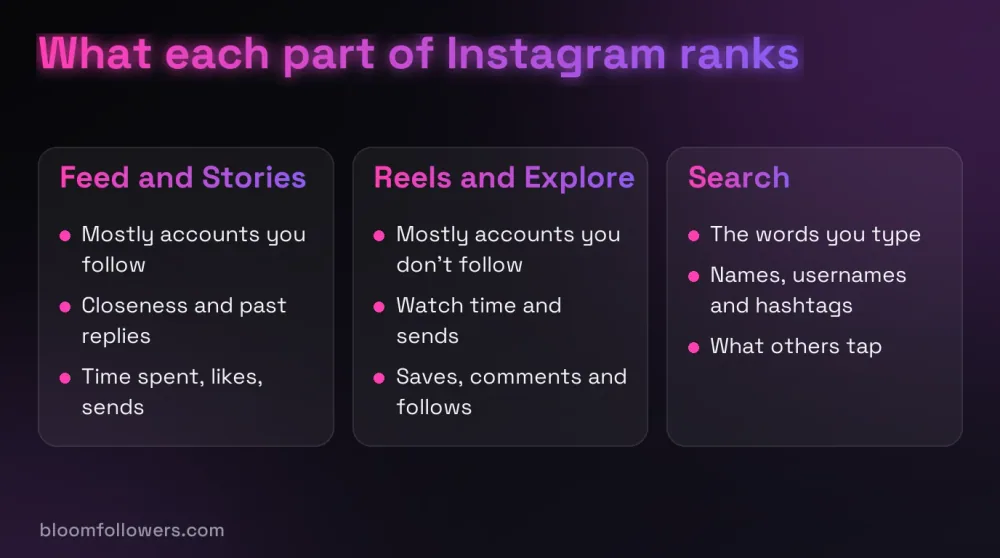
Each part of the app answers a different question. Feed and Stories mostly show accounts you already follow, while Reels and Explore exist to introduce you to new ones.
How Feed Ranks Posts
Your Feed mixes posts from people you follow with suggested posts from people you don't. Instagram lists four inputs, in rough order: your activity, information about the post, information about the person who posted, and your history with that person.
From those, it predicts what you will do next. Meta's ranking notes from June 2026 give examples: spending time on the post, swiping through a whole carousel, sending it in a message or opening the author's profile.
Suggested posts also get a quality check: how informative a post is, judged by an AI language model. If you would rather skip ranking, the Following view shows accounts you follow, newest first.
How Stories Are Ordered
Stories come from accounts you follow, and the order of that row leans on closeness. Instagram looks at how often you view someone's Stories, how often you reply or send likes, and signs that you are friends or family.
In January 2025, Adam Mosseri, the head of Instagram, named the Story actions that count most: tapping into a Story, liking it and replying with a message. A Story that gets those reactions makes your next one more likely to sit near the front of that viewer's row.
How the Instagram Reels Algorithm Picks Videos
Reels mostly shows videos from accounts you don't follow, so it has to guess what a stranger will enjoy. Meta's Reels notes, updated November 2025, list the actions it predicts, including whether you will:
- swipe away in under three seconds
- watch more of the video than most people watch of Reels that length
- reshare it, or send it outside Instagram
- use its audio in a Reel of your own
- follow the creator or leave a comment
Watch time counts seconds, not only the share of a video someone finished, so longer Reels are not punished for a lower completion rate, Mosseri said in February 2025.
How Explore Finds New Accounts
Explore shows posts from accounts you don't follow, close to topics you already engage with. Here the post itself comes first: Instagram checks how many people like, save and share it, and how quickly.
Next, it predicts your reaction, such as viewing a post for more than five seconds, watching over 95% of a video, saving it or following the author. Tapping Not interested on an Explore post tells the system to filter out similar ones.
How Search Ranks Results
Search works differently, because you tell it what you want. Your search words are the strongest signal, followed by your own activity and then how popular each account, hashtag or place is, according to Instagram's breakdown of Search ranking (opens in a new tab).
Meta's June 2026 notes add that Search matches your words against usernames, profile names and hashtags, then checks what people in your country tap for the same search. A clear name, plus keywords in your bio and captions, makes you easier to find.
How Does the Instagram Algorithm Work? The Signals That Matter Most
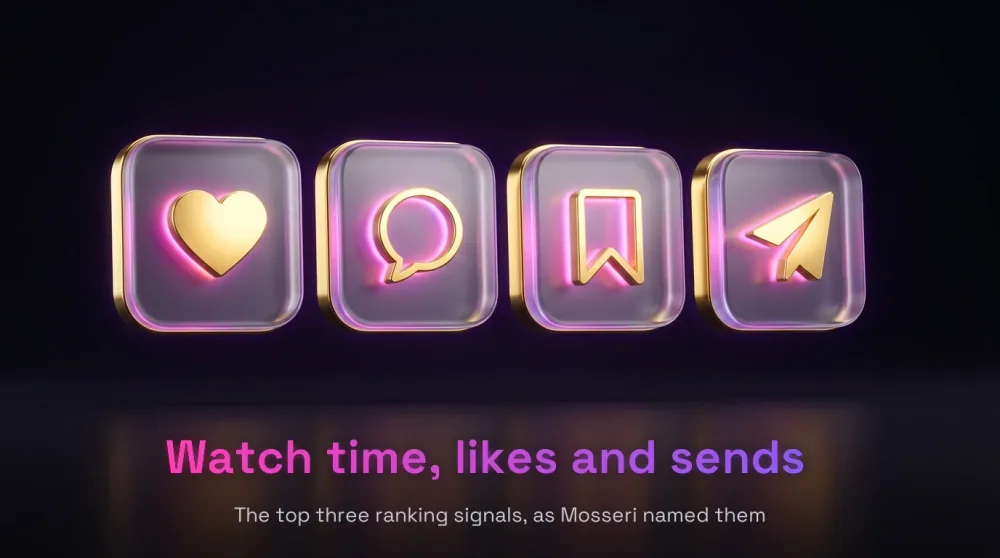
Across all five systems, a few signals do most of the work. Mosseri named the top three ranking signals (opens in a new tab) in January 2025: watch time, likes and sends.
He told creators to track average watch time, plus likes and sends per reach, meaning against how many people saw the post. So a small post that many viewers share can beat a bigger post that few people share.
Likes count slightly more when your followers see a post, while sends count slightly more when it reaches people who don't follow you. Comments are missing from his top three, although Meta's notes still list commenting among the actions Explore and Reels predict.
| Signal | What it measures | Where it counts most | Source |
|---|---|---|---|
| Watch time | Seconds watched and how much of a video people finish | Reels, Explore and videos in Feed | Adam Mosseri, January and February 2025 |
| Sends per reach | Viewers who share the post in a direct message | Reaching people who don't follow you | Adam Mosseri, January 2025 |
| Likes per reach | Likes compared with how many people saw the post | Reaching your followers | Adam Mosseri, January 2025 |
| Saves, comments and follows | What viewers do after seeing a post | Explore and Reels | Meta ranking notes, 2025 and 2026 |
| Your history with the account | Messages, replies, comments and likes between you | Feed and Stories | Instagram ranking explainer, May 2023 |
| Originality | Whether a post is the first upload, without another app's watermark | Reels, Explore and other suggestions | Instagram, 2023 to 2026 |
| Matching words | Your username, name, bio, captions and hashtags | Search | Instagram, 2021; Meta ranking notes, June 2026 |
Instagram Algorithm 2026: What Changed Recently
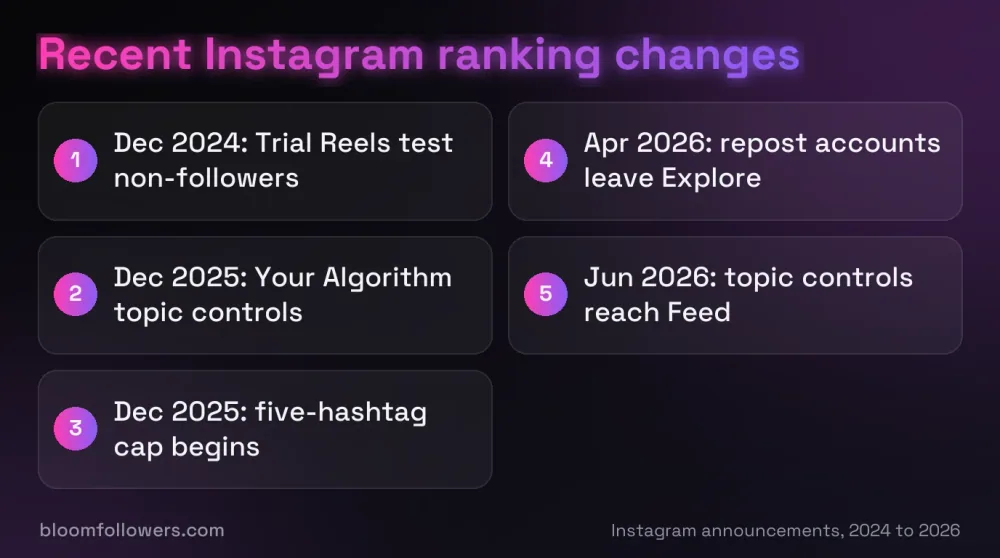
Most of the recent changes do one of two things: give you more say over what you see, or reward accounts that publish their own work.
You Can See and Edit Your Topics
In December 2025, Instagram launched a tool called Your Algorithm (opens in a new tab) for Reels in the US. It shows an AI summary of your interests, and you can pick topics to see more or less of, or type in new ones.
English-speaking users everywhere got it in January 2026. Explore followed in April, and the main Feed in June 2026, so one topic list now shapes all three. For a bigger clean-up, you can also reset your Instagram algorithm from Content preferences, which clears suggestions in Explore, Reels and Feed.
Original Posts Win Over Reposts
Since April 2024, Instagram has shown the original post instead of reposts (opens in a new tab) in recommendations, and it stopped recommending aggregator accounts that mostly share other people's videos.
On April 30, 2026, it extended that rule to photos and carousels (opens in a new tab). Accounts that mostly repost now lose their place in Explore and other suggestions for those formats too, though their followers still see those posts.
Adding your own commentary, steps or angle still counts as original, so third-party material is fine when you build on it.
Hashtags Matter Less Than They Used To
In December 2025, Instagram began rolling out a limit of five hashtags per post or Reel. Mosseri had already said that year that hashtags do not increase reach, though they still tell people what a post is about.
So a few specific tags beat a long list, and the best hashtags for Instagram work as labels rather than a reach trick.
Trial Reels Test Ideas on Strangers
Trial Reels, launched in December 2024 for professional accounts, show a Reel to people who don't follow you first. After 24 hours, you can see its views, likes, comments and shares, then decide whether to post it to your profile.
Since April 2026, you can also schedule when a trial reaches non-followers, which helps you line it up with the best time to post Reels.
The Ranking Signals You Can Control
You can't change how these systems work, but you can change what they measure.
- Win the first seconds. Reels predicts who will swipe away in under three seconds, so open with the payoff instead of a slow intro.
- Make posts worth sending. A useful tip, a joke made for one friend or a local find gets shared in direct messages, and sends help most with people who don't follow you.
- Upload your own originals. Instagram is less likely to recommend videos with a noticeable watermark from another app.
- Borrow an audience. A collab post appears on both profiles, so two sets of followers see it at once.
- Check Account Status. Posts that break the recommendation rules stop reaching non-followers, which many people call an Instagram shadowban.
Myth vs reality: Many people believe Instagram hides posts so you will pay for ads. Instagram's 2023 ranking explainer says it does not suppress content to push people toward ads, so check the signals above before blaming the ad business.
New accounts often get these habits right but have no social proof yet. That is the gap BloomFollowers fills, with views from real, active profiles delivered gradually to a fresh Reel.
When Paid Growth Makes Sense
Paid growth makes sense when your posts are already good and your profile simply looks new to first-time visitors. Some followers and activity on recent posts give those visitors a reason to look closer, while the ranking work above brings the next wave.
Every BloomFollowers order uses real, active profiles, and we only need your public username or a post link, never your password. Delivery starts within minutes and can be spread over several days at no extra cost.
Followers come with a 60-day refill, and every order has a 7-day money-back guarantee.
Our Instagram bundles put followers, views, likes and comments in one order. The Instagram Starter Bundle ($55.99) includes 1,000 followers, 5,000 views, 1,000 likes and 10 comments. For bigger launches, the Instagram Scale Bundle ($242.49) includes 5,000 followers, 25,000 views, 10,000 likes and 50 comments.
| Service | Starts at | Good for | Link |
|---|---|---|---|
| Instagram bundles | $55.99 (Instagram Starter Bundle) | Followers, views, likes and comments in one order | See Instagram bundles |
| Views | $1.99 for 500 views | New Reels that need a first audience | See view packages |
| Likes | $1.49 for 50 likes | Social proof on fresh posts | See like packages |
| Followers | $2.99 for 100 followers | A profile that looks established | See follower packages |

Get followers, views, likes and comments in one bundle, or pick a single service for your next post. Every order uses real, active profiles and gradual delivery, needs no password, and comes with a 7-day money-back guarantee.
Using the Instagram Algorithm in Your Favor
Instagram's ranking is really five systems, each rewarding a different action: closeness in Feed and Stories, watch time and sends in Reels and Explore, and clear words in Search. Pick the surface your next post is for, then make its key action easy: a strong opening, a reason to send it or a name people can search.
After a week, open Insights and compare that post's sends and average watch time with your last few posts. That comparison tells you more than any single trick.
Instagram Algorithm FAQs

What are the algorithms of Instagram?
Instagram uses separate ranking systems for Feed, Stories, Reels, Explore and Search instead of one algorithm. Feed and Stories focus on accounts you follow and how close you are to them. Reels and Explore recommend new accounts using predicted watch time, likes, saves and shares, while Search mostly matches the words you type.
How do I see my algorithm on Instagram?
Open the Reels tab and tap the slider icon at the top right to open Your Algorithm. It shows a summary of the topics Instagram thinks you like, and you can add topics or ask for more or less of each. It reached English-speaking users in January 2026 and now shapes Feed, Explore and Reels.
Does Instagram suggest people who look at your profile?
Profile visits are not on the list of signals Meta gives for suggested accounts. Its March 2025 explainer names mutual friends, whether an account already follows you and for how long, and how many people follow it. Contact syncing also feeds suggestions, and turning it off stops suggestions based on your phone contacts.
Does Instagram show your posts to all your followers?
Not always. Feed ranks posts for each follower by what they are likely to engage with, so people who rarely interact with you may see your posts lower down or miss them. Followers who switch to the Following view see posts from the accounts they follow in order, newest first.

Was this helpful?